)
Author: Chris Greenwald | Senior Insights Analyst
Keynote Kick-Off
ITC kicked off Wednesday morning with a keynote on the main stage. The initial speakers included Daymond John (CEO of FUBU) and William Powers (CEO and co-founder of Cambridge Mobile Telematics), with Contessa Brewer (CNBC correspondent) moderating. Much of the early discussion focused on the components of success and motivation. This included how hunger and resilience can push one forward into success, which transitioned into a conversation about how “healthy paranoia” can help prevent complacency within one’s business. This led to a discussion of how there can always be disruptors to your business, and if one remains complacent and lacks some paranoia, it can take a big hit to your business. William and Daymond then discussed the importance of not losing sight of who got you here in your business: your customers. They went on to discuss how listening to your customers and taking action based on the information they provide is extremely important.
After the discussions on motivation, customers, and success, the conversation transitioned into AI. Much of the discussion on AI focused on how AI is and will be utilized within companies. This included William discussing that Cambridge is using AI in any way possible, and he went on to discuss some things that will be disrupted by AI, including claims cycles, referencing how these innovations and moving-forward technology will most benefit the end consumer, whether by saving them time through the customer life cycle or even reducing overall costs.
When it comes to technology and insurance, it is hard to discuss both without AI coming into the conversation, and this will continue to be the case. It is fitting that the first speakers kicked off the conference by bringing up AI and what it means for employees, companies, and all industries.
Exploring the Expo Floor
As we saw last year, upon entering the expo floor, AI continued to be prominently featured on booths and displays, which aligns with the discussion held by the initial keynote speakers. This remained true no matter the size or nature of the company. Everyone is looking for ways to use AI to help their organizations grow, innovate, and simply keep up with their competitors and potential future competitors. The implementations of AI observed across the expo floor included agentic AI, AI platforms, embedded AI, and AI-powered underwriting, claims, quoting, and more. The push for the utilization and application of AI continues to develop and grow, and we anticipate that it will continue to push forward with no slowing in sight.
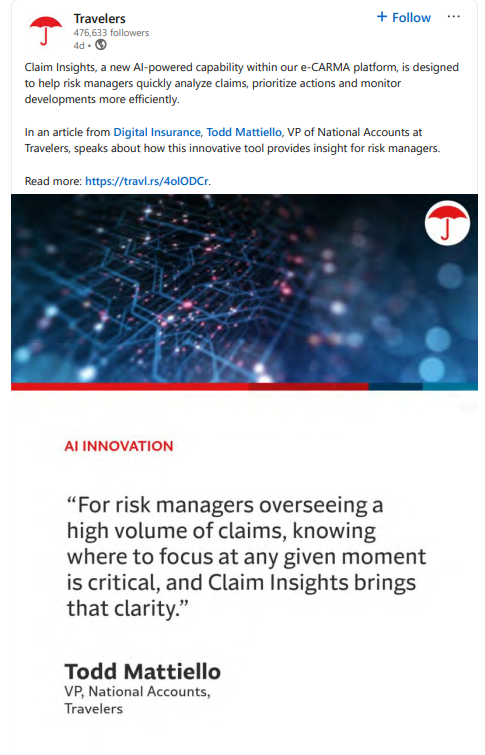
One example Competiscan observed back in June 2026 that reinforces this AI push forward is Travelers promoting a new AI-powered capability within its e-CARMA platform on social media. This platform is described as being able to help risk managers quickly analyze claims, prioritize actions, and monitor developments more efficiently.
The Future of Property Risk Intelligence
During a seminar, speakers discussed the future of property risk intelligence and how it begins with the inside of the home. They emphasized how we already collect an abundance of data on the outside of the home, whether acquired through aerial imagery or other avenues. The outside data was described as valuable but not telling the full story. The missing data points are around the inside of the home; this could include where certain things are located, such as whether the water heater or laundry room is on an upper floor. While exterior data is easier to gather, data on the inside of the home can be more difficult to obtain, since an inspection is usually needed to collect the additional data. The speakers discussed changing the conversation surrounding home inspections from making sure they qualify to making sure the home is safe.
The speakers were then asked to provide some information on what insurers can do to stay ahead. The main takeaways included looking at the future of property risk as an opportunity to reduce risk and drive down prices, collecting as much data as possible, and creating innovation in what you are trying to accomplish. It will be interesting to see how companies address the future of inside-the-home risk data and what that will mean for customers.
What’s Next?
We continue to see innovation across the industry when it comes to technology, with a heavy emphasis on AI implementation. Whether this is focused on claims, quoting, underwriting, customer experience, or other areas, insurance companies will continue to move forward with their AI and technology initiatives and how they can enable their employees and, in effect, support their customers. It’s exciting to see how this will move the industry forward and what’s next when it comes to these advancements.