)

Author: Lindsay Clark | Director, Research & Insights
There is no shortage of conversation about AI these days. Real questions are being raised about whether its capabilities need to be restrained or whether communities can handle its infrastructure. While people debate ethical questions, AI is being integrated everywhere, including the workplace, the home, and even people’s banking or investing apps. Despite ongoing concerns, AI adoption continues to grow, and consumers are becoming increasingly willing to use and trust these tools. Financial institutions carefully toe this line, using language like “talk to a human” or “humanizing banking”, while innovating new AI-powered in-app or portal tools designed to foster customer engagement and loyalty. Fintechs like SoFi and Cash App have prominently highlighted their AI customer tools, while traditional banks have given subtle nods through “financial assistants” or chatbots. While approaches vary, financial institutions increasingly view AI-powered assistants as a way to deepen customer engagement, provide personalized financial guidance, and strengthen long-term loyalty.
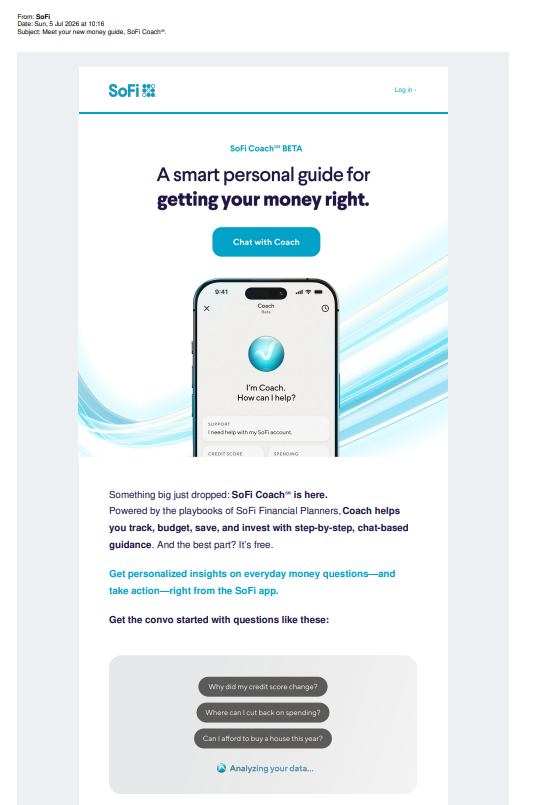
In early June 2026, SoFi launched its “SoFi Coach”, a personalized insights tool in which customers get AI chat-based guidance on money topics like tracking, budgeting, saving, and investing. Its early email campaigns featured screenshots of the tool and the message “Chat with Coach.” Notably, a small disclosure at the end of the email noted, “Coach is backed by bank-grade security and privacy standards, so your data stays safe,” showing the fintech’s understanding of consumer hesitation.
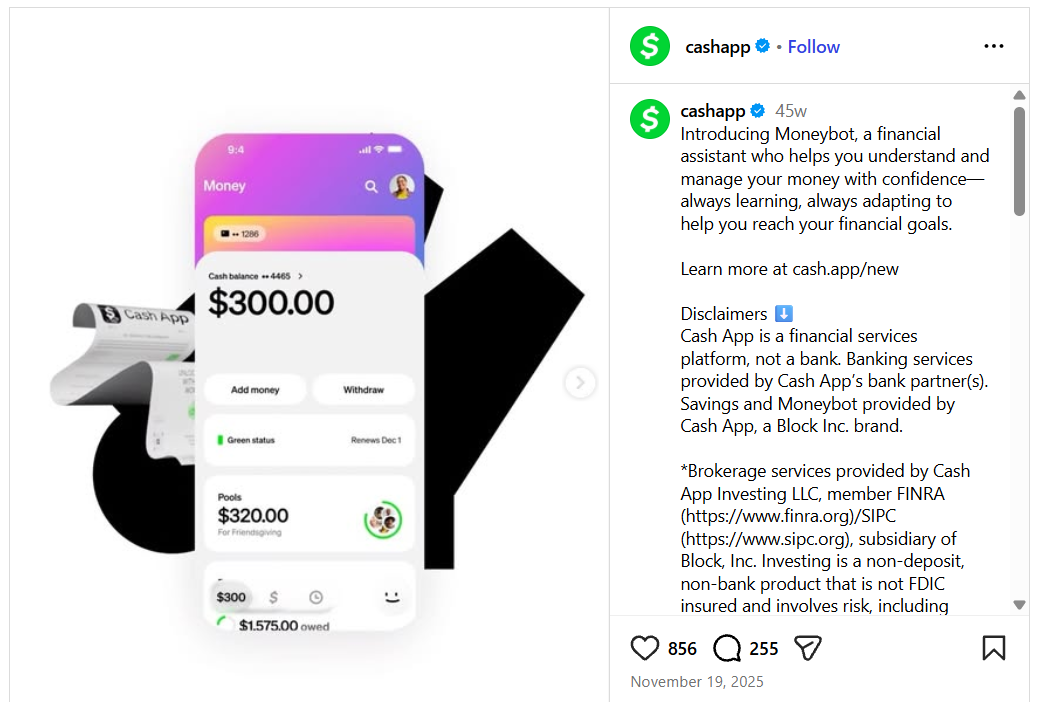
Another fintech, Cash App, announced its new tool, Moneybot, on social media in November 2025. Moneybot, leans into agentic capabilities to provide similar tasks to SoFi’s Coach, such as creating a savings plan or evaluating spending. In an online video demonstrating the tool, the fintech poses a hypothetical question for a customer to ask Moneybot, “How’s my grocery spending this week”? The tool then outputs a quick bar chart of weekly grocery spending and suggests ways to use leftover grocery budget to save. Rather than requiring users to navigate multiple screens and interpret spending data themselves, Moneybot translates transaction activity into personalized insights and recommendations through a conversational interface.
While fintechs increasingly embrace generative AI, many traditional financial institutions still rely on non-generative AI and natural language processing to power their digital assistants. Assistants like “Pat” from Patelco Credit Union, “Berry” from Salal Credit Union, and “Emmi” from Empower Federal Credit Union are just a few humanized 24/7 app and portal assistants in the industry, designed to give customers quicker answers to banking questions. National banks have also introduced branded tools: U.S. Bank offers Smart Assistant, Fifth Third Bank has Jeanie, and Bank of America has Erica. Although these tools are not yet fully generative, they show how much banks value conversational customer experiences. In the coming years, banks will likely use their existing tools and improve their digital assistants with more up-to-date AI technology. Bank of America has already announced plans to revamp Erica into Erica 2.0.


The innovation behind these tools lies in their ability to move digital banking beyond passive self-service and toward proactive financial guidance. By transforming account and transaction data into personalized insights through natural conversation, these assistants help customers make more informed financial decisions while increasing engagement for financial institutions. As banks and fintechs continue to enhance these capabilities, those that successfully combine convenience and personalization with transparency, security, and easy access to human support will be best positioned to earn customer trust and strengthen long-term loyalty.