)

Author: Jessica Duncan | AVP, Research & Insights
As the 2026 holiday season approaches, marketers for financial services are moving beyond traditional rate- and fee-focused messaging to address consumers’ growing sensitivity to budgeting and spending. Campaigns captured by our consumer panel have increasingly highlighted themes of affordability, savings, and financial flexibility, with messaging such as “stretch your holiday budget,” “putting money back in your pocket,” and “seasonal fun without breaking your budget.” The tactics reflect a broader effort to connect with consumers’ immediate financial realities, particularly during a season often associated with elevated expenses.
Banking: Holiday Budgeting Tools and Financial Wellness
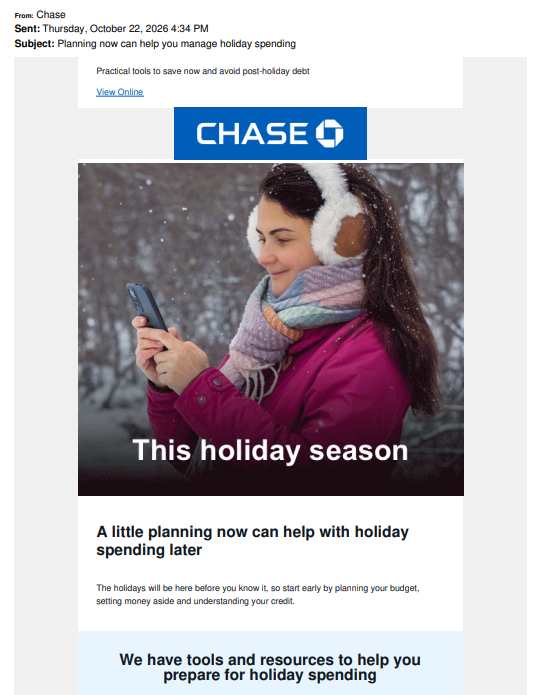
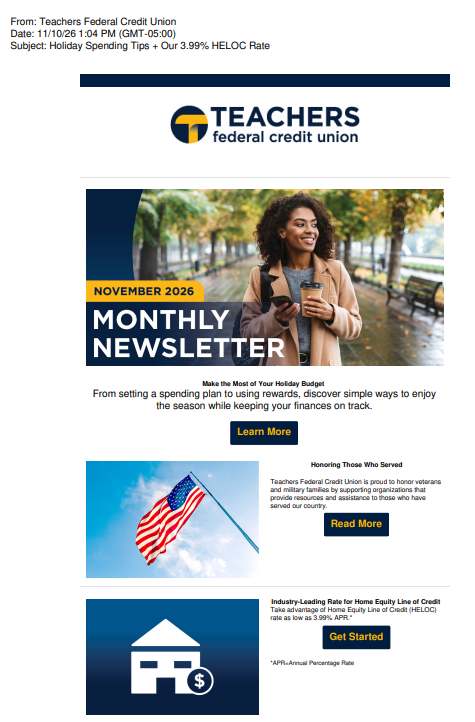
Messaging favored educational content and budgeting tools over product pitches. Chase released an October email prompting customers to start planning now to help with their holiday spending later. OneAZ Credit Union shared “9 simple holiday budgeting tips” under the headline “Holiday Cheer Starts with a Smart Budget,” promising members they could enjoy the season without the financial stress. Teachers Federal Credit Union devoted the lead feature in its November e-newsletter to holiday spending, encouraging members to create a holiday budget and stay focused on long-term financial goals to avoid seasonal overspending. Bellco Credit Union presented a four-step holiday budgeting framework, “1) Pick Your Total… 2) List Everything, Not Just Gifts… 3) Assign Amounts and Add a Cushion… 4) Decide How You’ll Pay…,” positioning itself as a personal finance coach by offering practical money-management guidance rather than traditional banking promotion.
 |
 |
 |
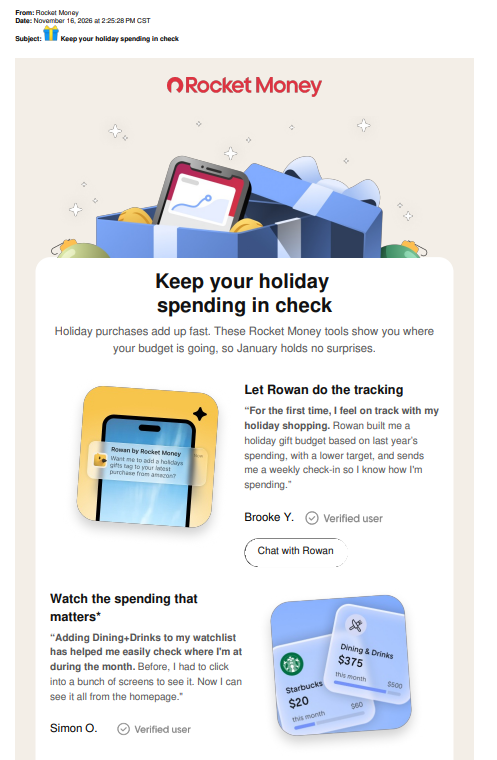
Beyond budgeting and savings messages, tech-enabled tools remain a central strategy for helping consumers understand and manage their complete financial picture. Rocket Money introduced Rowan in August, an AI-powered financial assistant that works primarily through text messaging. A recent seasonal email urged customers to “Keep your holiday spending in check,” noting that holiday purchases add up fast. The email featured three testimonial-style use cases, including one from a customer named “Brooke Y.,” who said: “For the first time, I feel on track with my holiday shopping. Rowan built me a holiday gift budget based on last year’s spending, with a lower target, and sends me a weekly check-in so I know how I’m spending.”
 |
Lending: Smart Spending, Rewards Redemption, and Breathing Room
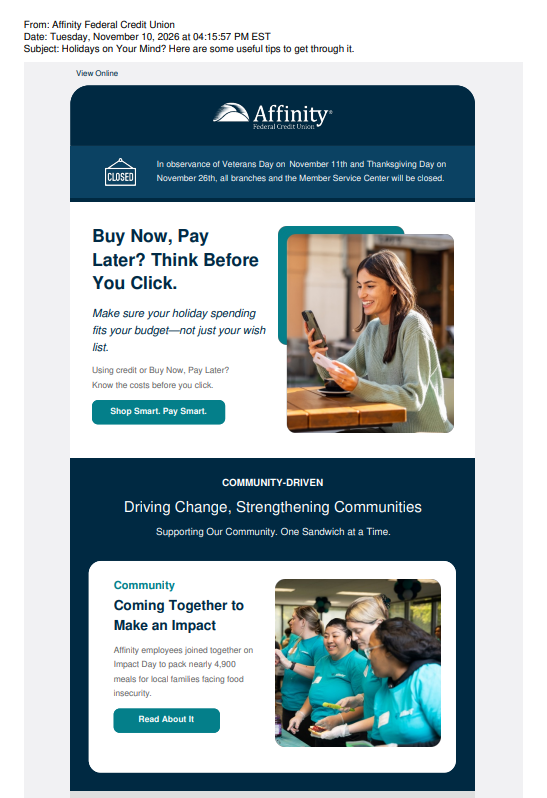
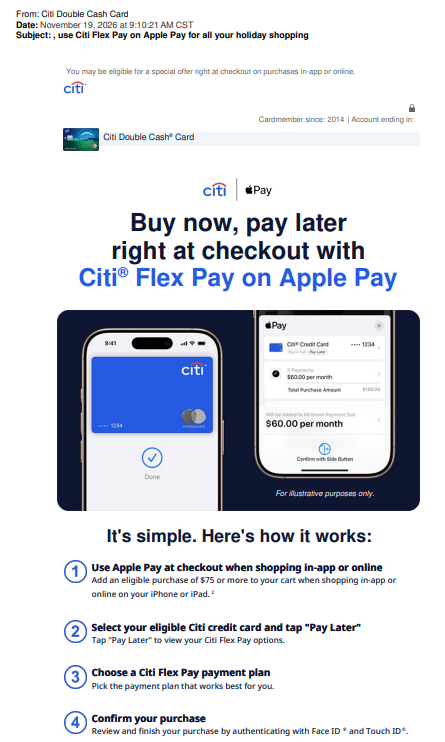
Credit card issuers emphasized financial control, positioning their cards as management tools rather than just spending vehicles. Affinity Federal Credit Union urged cardholders to think before they used a Buy Now, Pay Later payment option, reminding them, “Make sure your holiday spending fits your budget, not just your wish list.” Meanwhile, Citibank directed its cardholders to use the Flex Pay feature directly within Apple Pay for their holiday purchases.
 |
 |
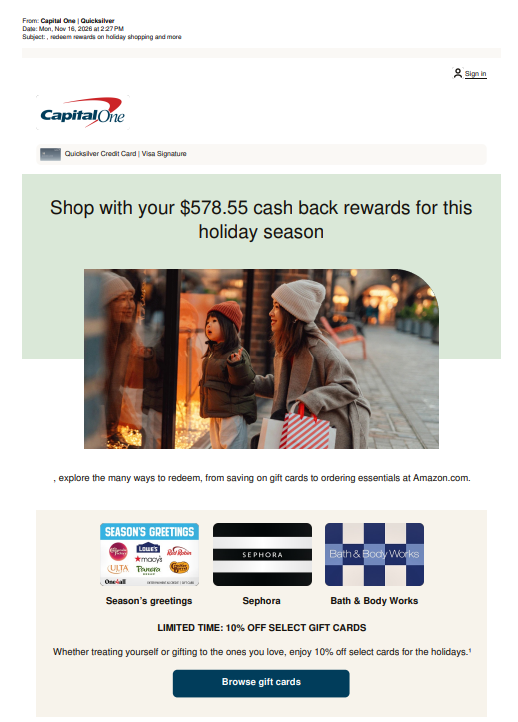
Card marketers are placing greater emphasis on the everyday value of rewards redemption, reinforcing the message that cardholders can unlock meaningful savings through ongoing card engagement and flexible redemption opportunities. In a holiday-themed email, Capital One inspired its cardholders to use their existing rewards balance to pay for gifts on Amazon.com or to take advantage of discounted gift card redemption options.
 |
Lenders promoted personal loans as a way to help consumers make more room for holiday spending. U.S. Bank struck an emotional chord by stating that “holidays should be about gathering, celebrating, and making memories, not worrying about multiple credit card balances.” The personal loan offer went on to suggest that by consolidating high-interest debt and making room for their holiday budget, consumers could go into the new year with “more clarity, more control, and more confidence.”
 |
This holiday season’s campaigns suggest that financial brands are competing less on rates and rewards alone and more on their ability to help consumers feel financially confident and in control. Whether through budgeting guidance, AI-powered tools, flexible payment options, rewards redemption opportunities, or debt consolidation solutions, the most effective messaging recognized a common consumer goal: enjoying the holidays without carrying financial stress into the new year. For marketers, the opportunity extends beyond the seasonal moment. As attention turns to the new year, these efforts can create lasting value, positioning brands as trusted financial partners during a period when many consumers are focused on saving more, reducing debt, and strengthening their financial habits.